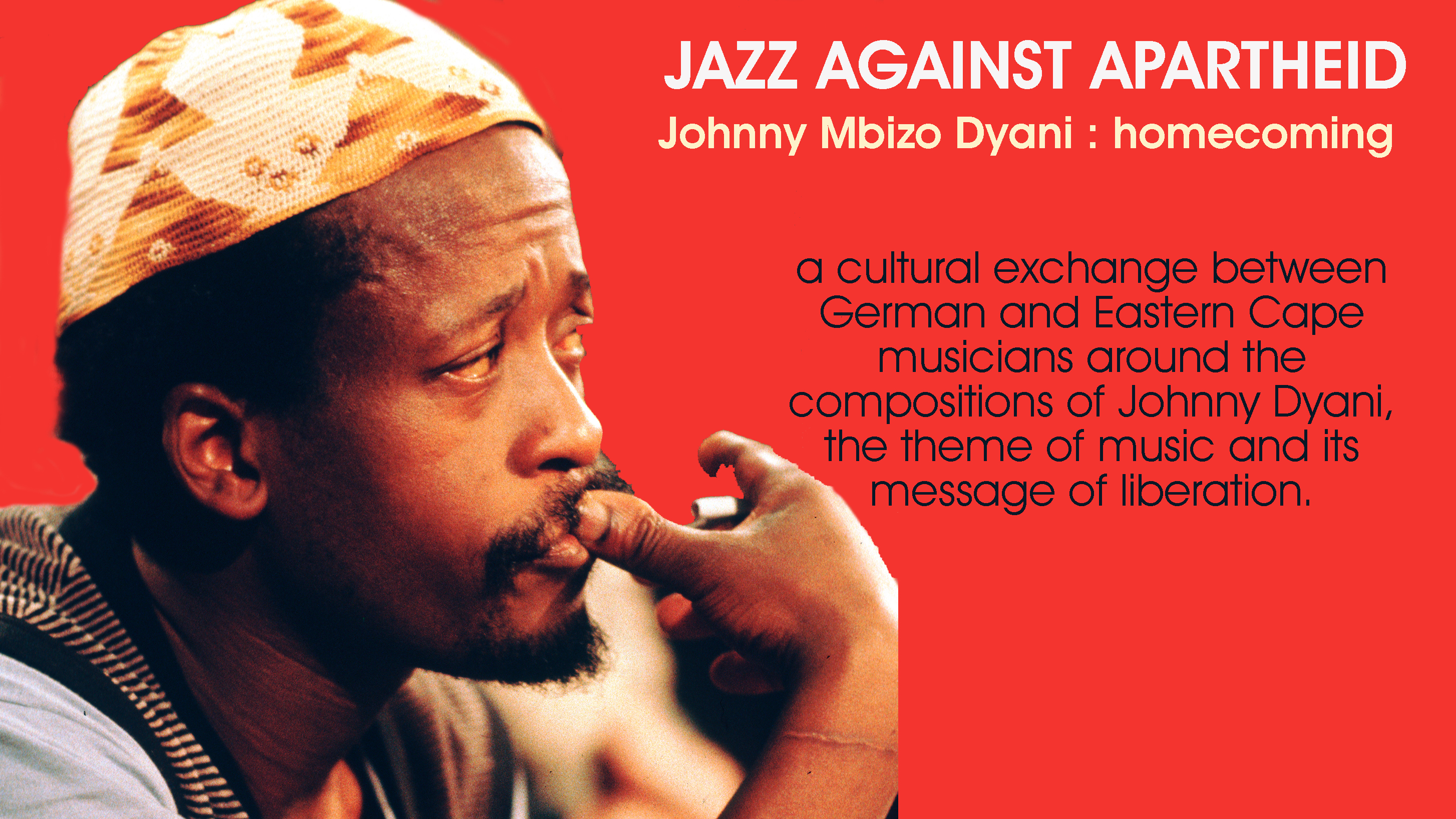
Dyani’s compositions show the merging of folk music and jazz music. He took the functionality of folk music and combined it with the freedom of jazz, to build a community abroad that fought the struggle against Apartheid and won. His compositions bridged music and society, and his harmonic approach had the effect of bringing solidarity and change to the social disharmony. It is a timeless approach. Dyani’s wife Magdalena confirmed his deep sense of African music: “He loved African folksongs religious music and church choirs. He sang in Xhosa, chanted and danced on stage. He was aiming to develop a creative interest beyond tribal stereotypes.”
Dyani performed this music throughout the seventies and eighties with a diverse group of musicians from South Africa, America, Turkey, North Africa, Caribbean, UK, Sweden and France. Through far reaching musical collaborations in exile, he was a forerunner of unity through diversity, or uBuntu as we have come to know it in South Africa.
As he said, “I’ve had interracial bands because I believe in the unity of the universe.”
And as a result his music crossed over into multiple genres: “I am a folk musician,” said Dyani, “and I don’t like to see my work described as jazz because it introduces connotations that I don’t regard as relevant.”
"I did it for my country, for my people," Johnny Dyani
Dyani’s vocal conception of bass playing began as a young child growing up in Duncan Village. His first instrument was the voice and he was a terrific singer. He then moved to piano and began singing and playing at an early age with another resident of Duncan Village Tete Mbambisa.
By the age of Twelve, Dyani took up bass and played in Dick Khoza’s group, Jazz Wizards, with Mongezi Feza, Dudu Pukwana, Pinise Saul, Pat Matshikiza and Aubrey Semane.
In July 1964, still only 17 years of age, Dyani went into exile with the Blue Notes, Chris McGregor, Dudu Pukwana, Mongezi Feza and Louis Moholo. The Blue Notes influenced a lot of musicians in Europe and created a new language of a free music built on a deep African soul. And they were extensive in their impact.
Dyani had a certain magic about his playing. He was a magician of the ostinato; the repeated musical phase. Dyani’s ostinato’s were the glue that bound his compositions together, allowing the other instruments and voices to layer their expressions on top to create a kaleidoscope of sound that crossed in and out of many genres.
“Johnny Dyani might well be dubbed an ostinato magician for his ingenuity in inventing melodically striking and rhythmically driving repetitive figures. These patterns are generally one or two bars in length, often related in tonality to the pitches of the bass‘ open strings (E, A, D, G) and form the primary building blocks of most of his pieces. Variety is obtained either by transposing the ostinato figures (mostly by a fourth or fifth), by juxtaposing sections with different ostinati or by alternating ostinato patterns and walking bass sections or rubato passages. Music examples 1-6 offer some characteristic examples of ostinato figures drawn from Dyani’s compositional output. It has to be added that repetition as a principle is also a salient feature of Dyani’s bass playing in a freely improvised context.” Wilson
Acknowledgements
Built around the timeless musical compositions of Johnny Dyani: 30.11.45 – 24.10.86: Jazz Against Apartheid is a complete archive of 30 years of exile history. The musical collaboration around the work of Dyani continue to inspire. Jazz Against Apartheid is a complete archive of 30 years of exile history. The musical collaboration around the work of Dyani continue to inspire. It is a profound cross-fertilization and is developed on a foundation of 30 years of exile history from friendships born and united in South Africa's struggle for freedom.

Sausage Films